
Part 2 of a three-part series on Michigan’s 2026 election
By: Chris Moyer
November 18, 2026
From minority to majority
Two years ago, Michigan Democrats lost the state House 58-52 and with it the trifecta they only momentarily held. On November 3 they won it back, with far more room than the 56-54 majority they held in 2023 and 2024. House Democrats flipped 11 seats for a 63-47 majority, defeating 10 Republican incumbents and winning an open Republican seat, and won all 23 battleground districts. Senate Democrats expanded their majority from 20-18 to 23-15, their largest since 1982.

Those two numbers, 63 and 23, will shape the next two years in Lansing more than any single race on the ballot.
Where the majorities were won
The legislative majorities were not won in Detroit or Ann Arbor, which Democrats already hold. They were won in the middle suburbs, Downriver, the mid-sized counties and the West Michigan suburbs, the same kinds of places where Benson ran ahead of El-Sayed.
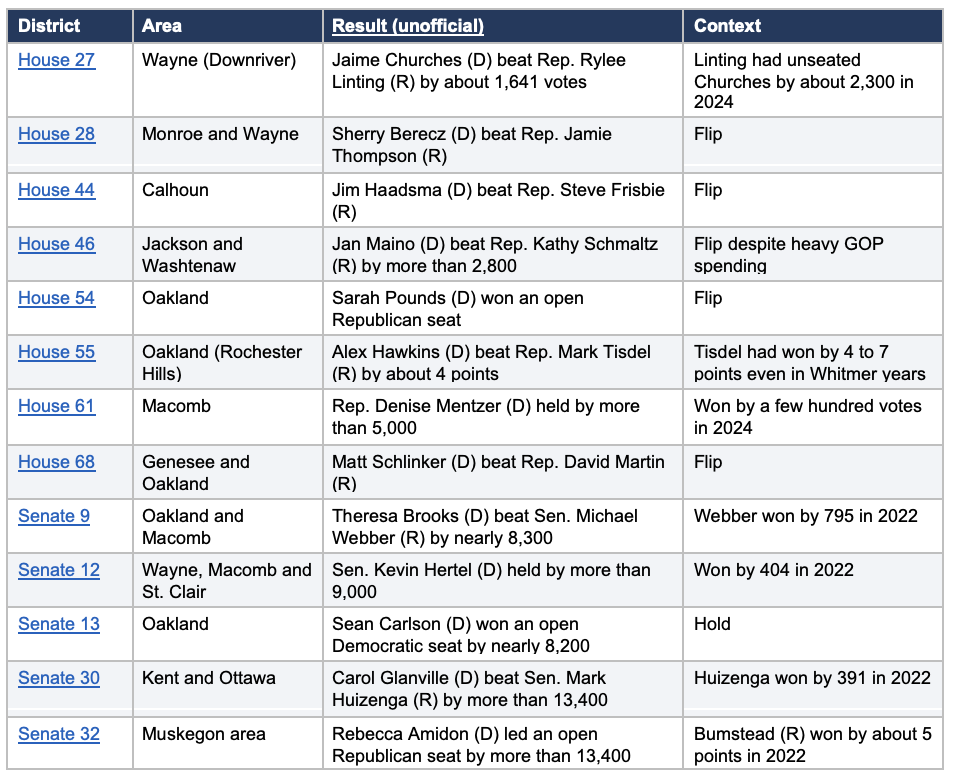
Who is in the new Legislature
The election did not just change which party controls Lansing. It changed who is there. In the House, Democrats defeated 10 Republican incumbents and flipped an open seat, and 34 members-elect were not in the outgoing House, 26 Democrats and 8 Republicans, a few of them former members returning, like Churches. In the Senate, 23 of 38 members will be new to the chamber, 14 Democrats and 9 Republicans, though at least 12 of them are current or former House members. Michigan’s term limits, which cap legislators at 12 years across both chambers, guarantee this kind of turnover. What is unusual this time is that it comes alongside a change in power.
The leaders
Both caucuses chose their leaders two days after the election.
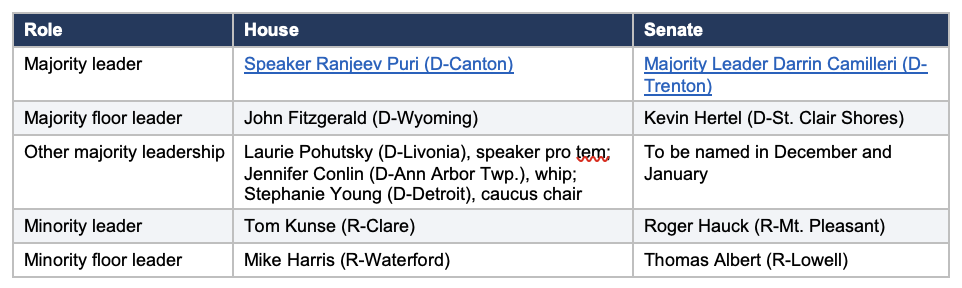
The Democratic leadership map mirrors the coalition’s center of gravity. Puri represents Canton, Pohutsky Livonia and Camilleri Trenton, all in suburban Wayne County. Hertel represents Macomb’s St. Clair Shores, the middle suburbs that Part 1 identified as the place where the majority lives, and Fitzgerald represents Wyoming in Kent County. Puri will be the first Indian American and Sikh speaker in the House’s history.
Republicans changed course too. House Republicans replaced outgoing Speaker Matt Hall with Kunse, who promised a more collaborative approach and told reporters that Democrats are not the enemy. Senate Minority Leader Hauck named education, housing and health care costs as areas of possible common ground, and Camilleri listed energy, housing and prescription drug affordability among his priorities. The overlap is worth noting: affordability is the issue both sides say they want to own.
The new members
The 40 Democrats joining a chamber they did not serve in this term come from every part of the coalition described in Part 1, according to the Michigan Health & Hospital Association’s roster of members-elect.
Three features of this class stand out. First, it is geographically balanced: roughly a third of these Democrats come from Detroit, Dearborn and Downriver, a third from the Oakland, western Wayne and Macomb suburbs, and a third from mid-Michigan, West Michigan and the north. Second, it includes new Democratic members from places that rarely send them, such as Holland, Shelby Township, and Lake Orion. Third, it brings historic firsts: Joanna Whaley of Allen Park will be the first transgender woman to serve in the Legislature, and she campaigned, like many in this class, on utility bills, health care costs and medical debt.
The math of a working majority
The size of the majority changes how Lansing will work. In the last Democratic House, a 56-54 majority meant every Democrat had to vote yes for a bill to pass. With 63 seats, House Democrats can lose seven of their own members and still reach the 56 votes needed. In the Senate, 23 Democrats can lose three and still reach 20.
That cushion is both a strength and a test. It lets leaders pass bills without winning over every member, but it also means members from swing districts can vote no without killing a bill, which makes it easier for them to separate themselves from the caucus when an issue is unpopular at home. Puri has called the caucus’s diversity its greatest strength, while acknowledging the diversity of thought it brings. A caucus that stretches from Detroit and Dearborn to Holland and Lake Orion will not always agree, and how leaders manage those disagreements is the first governing test Part 3 will examine.
What the legislative map tells us
Put the district results, the leadership choices and the new members together, and two lessons emerge.
The majority rests on the thinnest part of the coalition. Democrats did not need Detroit, Ann Arbor or Lansing to win control; those seats were already theirs. The new seats came from Downriver, Macomb, the Oakland suburbs, Jackson, Calhoun and the Kent-Ottawa line, the same places where voters split their tickets and where Benson ran ahead of El-Sayed. Power in Lansing depends on where the coalition is narrowest, not where it is strongest.
The caucus is unusually broad. It runs from Detroit and Dearborn to Holland and Shelby Township, and a large share of its members will be new to their chamber in January. That breadth won the majority. It will be harder to manage when those members have to vote together on budgets, energy policy and taxes.
Part 3 picks up from here: what Democrats need to do in Lansing to keep this coalition together, which decisions will test it, and which early signals will show whether it is holding.