
Part 1 of a three-part series on Michigan’s 2026 election
By: Chris Moyer
November 17, 2026
What happened on November 3
Winning an election is about building a coalition. Governing is about maintaining it. Michigan’s 2026 results show both how broad the Democratic coalition became and where it is already under strain.
The headline numbers are decisive. Jocelyn Benson beat John James by more than 10 points for governor, and Abdul El-Sayed beat Mike Rogers by about 7 for the U.S. Senate, both on unofficial results. More than 4.8 million Michiganders voted, an apparent midterm record. Every one of Michigan’s 83 counties moved toward Democrats compared with 2024, according to the Associated Press.
Their wins carried the rest of the ballot. Democrats flipped the state House and expanded their state Senate majority, taking full control of Lansing, a story Part 2 of this series tells district by district.
Who showed up, and who stayed home
Building a coalition starts with turnout, and the raw vote totals tell a clear story. Benson won about 2.61 million votes, roughly 96% of the 2.74 million Kamala Harris won in a presidential year. James won about 2.09 million, roughly 74% of Donald Trump’s 2.82 million. Democrats gave up about 123,000 votes from 2024. Republicans gave up about 722,000.
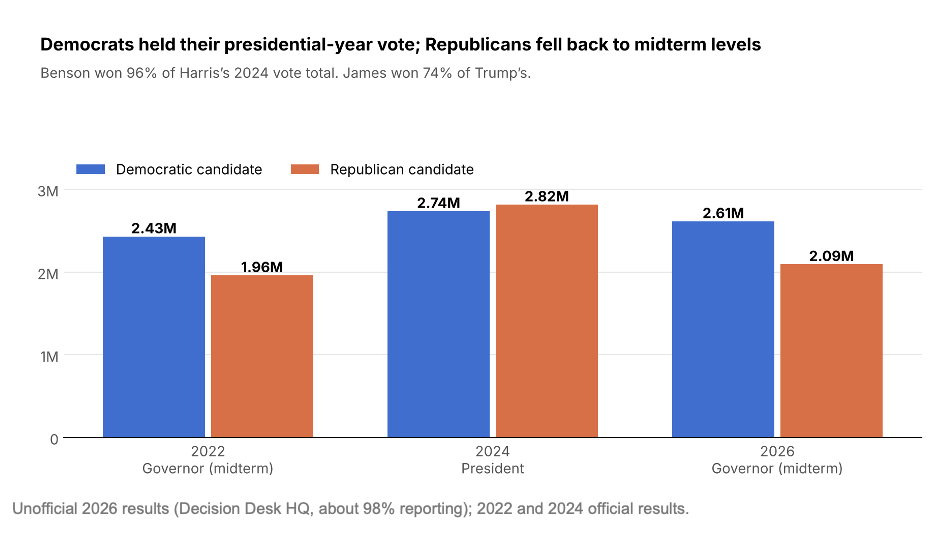
That difference of about 600,000 votes matches the full swing from Trump’s 80,000-vote win in 2024 to Benson’s 519,000-vote win. But it would be a mistake to read the result as Republicans simply staying home, for two reasons.
First, Republicans turned out like a normal midterm party, not a collapsing one. In 2022, Tudor Dixon won about 1.96 million votes, roughly 74% of Trump’s 2020 total, almost exactly James’s share this year. James actually won about 134,000 more votes than Dixon did. What changed was the Democratic side. In 2022, Gretchen Whitmer won about 87% of Joe Biden’s 2020 vote. This year Benson won about 96% of Harris’s. Democrats turned out at close to presidential-year levels in a midterm, and that is the clearest sign of a coalition being built rather than inherited.
Second, net totals hide voters who changed sides. Dearborn moved from a 6-point Trump win to a 65-point El-Sayed win, and all 83 counties moved toward Democrats, including deep-red rural ones. Statewide totals cannot separate a 2024 Trump voter who stayed home from one who switched; precinct and voter-file data available after certification will. What the totals do show is that Democrats built this win mostly by bringing their own voters out at presidential-year rates, while persuasion at the edges decided the places where Benson and El-Sayed ran apart.
Two candidates, two coalitions
Benson and El-Sayed won on the same night, but not with the same voters. Benson’s winning margin was about 520,000 votes to El-Sayed’s 320,000, and she ran ahead of him in all 83 counties. She carried 18 counties to his 14. The four she won and he lost, Macomb, Berrien, Clinton and Benzie, show where the Democratic coalition is widest and where it is thinnest.
Macomb County is the clearest case. Benson won it 51% to 47% while El-Sayed lost it 50% to 48%. In Oakland County, Benson won 60% to 39%, while El-Sayed won 56% to 42%. That is a 7-point gap in margin in the state’s second-largest county. Statewide, the gap between the two was about 200,000 votes, roughly 4 points of margin, narrower than the pre-election polls suggested. The crossover vote was real, but it was concentrated in the suburbs, and it was not large enough to change the outcome.
The split was not only a suburban story. According to MLive, Benson’s biggest edges over El-Sayed came in rural northern counties and in Oakland, Haley Stevens’s home county.
The lesson is not that one candidate’s coalition was right and the other’s wrong. It is that the two overlapped heavily but not completely, and the voters at the edges pulled in opposite directions. Holding both edges at once is the central governing challenge for Democrats, and it begins in the Legislature.
Who is in the coalition
Put the county and district results together and the 2026 Democratic coalition has seven distinct parts. Each held for a different reason, and each will need something different from the people now governing.
Detroit. Benson won about 93% of the city and El-Sayed about 92%, both above Harris’s 90% in 2024. The base did not just hold; it grew.
Arab American and Muslim voters. Dearborn swung from a 6-point Trump win in 2024 to a 65-point El-Sayed win, with record turnout. Pre-election polling of Muslim voters showed 97% for El-Sayed and 84% for Benson. This is the part of the coalition that left in 2024 and came back.
Jewish voters and Oakland’s suburban moderates. These voters stayed with Benson but split on El-Sayed, as an exit poll of Jewish early voters showed: 78% backed Benson and 57% El-Sayed. They remain in the coalition, but with conditions, and their communities anchor several of the new Oakland House and Senate seats.
The middle suburbs. Macomb moved about 17.6 points toward Benson compared with 2024, and Downriver and Monroe-area House seats flipped. This is where the legislative majority lives, and where voters are most willing to split their tickets.
College towns and young voters. Washtenaw gave El-Sayed 74% and Benson about 75%, above Harris’s 71%. Both also outran Harris in Ingham, Kalamazoo, Isabella and Kent counties.
West Michigan. Kent County moved about 10 points toward Benson and 8.5 toward El-Sayed from 2024. Even reliably Republican Ottawa moved, from 39% for Harris to 42.6% for Benson, and the Kent-Ottawa Senate seat flipped by more than 13,000 votes.
Small-town and rural Michigan. Every county moved toward Democrats compared with 2024, including double-digit shifts in Dickinson, Branch and St. Joseph. But in Oscoda, Ogemaw and many other rural counties, Benson and El-Sayed ran behind past Democratic midterm candidates. This is the weakest link in the coalition, and the one most dependent on the national environment.
Voters interviewed from Detroit to Wexford County described their ballots the same way: as a vote against Trump. A coalition built in opposition is easier to assemble than one built around a record. Starting in January, Democrats in Lansing will have a record.
What comes next…
Part 2 follows this coalition into the state House and Senate districts that gave Democrats their majorities.