
by Chris Moyer
On Sunday, two days before Election Day, Rep. Haley Stevens endorsed Republican Mike Rogers for the U.S. Senate after sitting beside him at Perfecting Church in Detroit. Stevens, who lost the August primary to Abdul El-Sayed, had told Democratic leaders the night before that she would vote for the Democratic nominee. The reaction to Stevens’ decision was swift. Much of her staff resigned, President Trump praised her, and Senate Democrats closed ranks around their nominee.
What it means for the outcome is a narrower question. By the time Stevens spoke Sunday morning, about 2.2 million Michiganders had already voted, roughly half the 2022 electorate. The endorsement can reach only Tuesday’s voters, and only those still persuadable. Late endorsements rarely move many votes, but Rogers lost by 19,000 in 2024, so even a small effect counts.
Here is what the ballots themselves tell us.
What has already happened
By Monday morning, after early voting closed with a record Sunday of 114,420 in-person ballots, 2,313,165 Michiganders had voted, 31.2% of active registered voters. The final weekend was the busiest stretch: more than 620,000 ballots arrived in four days, and in-person early votes more than doubled.
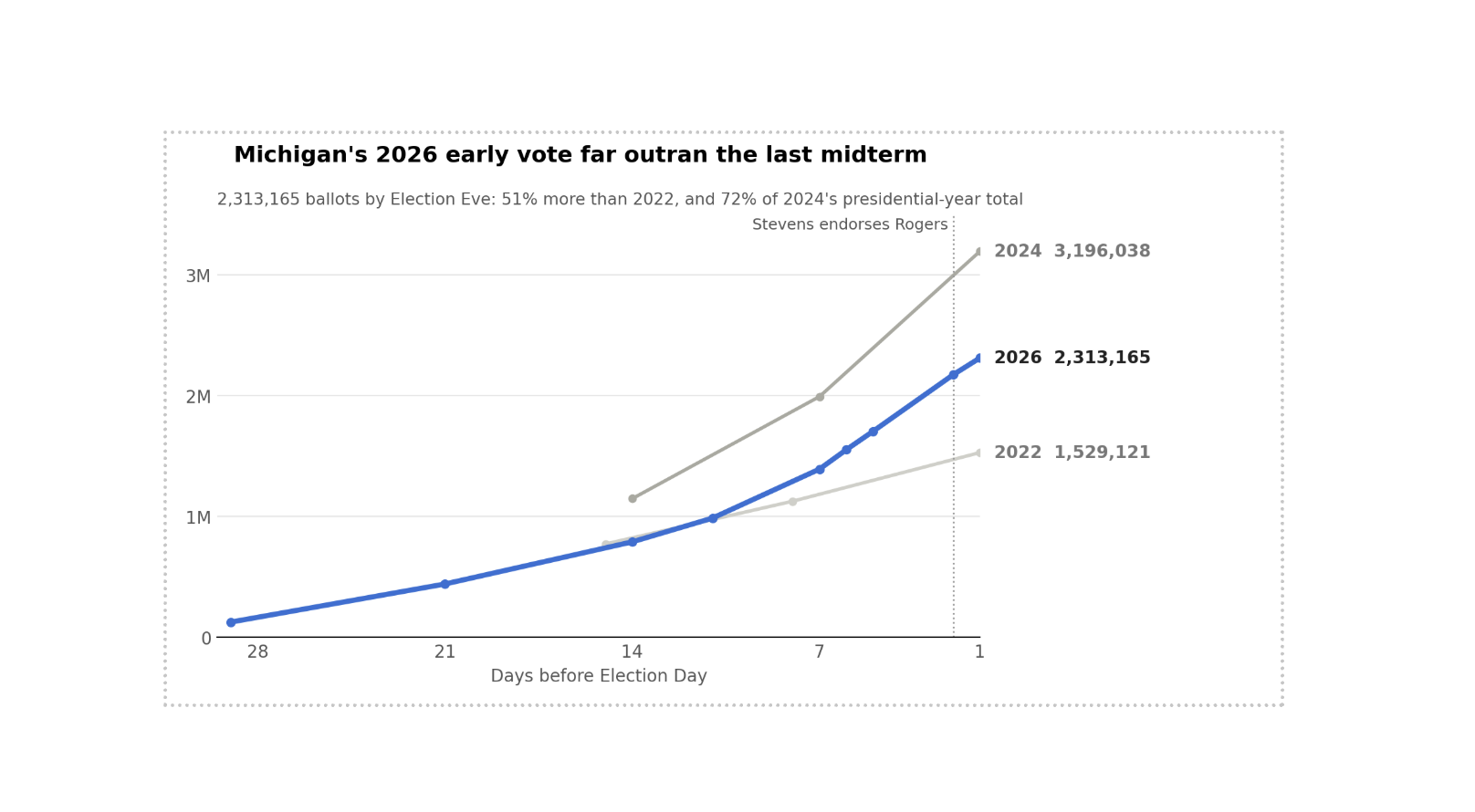
Source: Michigan Department of State releases and dashboard snapshots: 2026 (Oct. 5 to Nov. 2), 2024 (Oct. 22 to Nov. 4), 2022 (Oct. 24 to Nov. 7).
About 2.2 million ballots were already in when Stevens spoke Sunday morning, and the record day of in-person voting that followed pushed this midterm’s early vote well past 2022.
Note: Michigan did not offer early in-person voting in 2022. Voters approved it that November, and it was first used statewide in 2024, so the 2022 line counts absentee ballots only. Part of this year’s gain over 2022 reflects that new option, not just higher turnout.
Where those ballots come from matters more. For most of October, the nine counties Kamala Harris won in 2024 supplied about 52.5% of the early vote, the same as in 2022 and 2024. Over the final weekend, that rose to 53.2%, a small but first measurable tilt toward Democratic-leaning places. Wayne leads the state with more than 339,000 ballots, and Wayne, Oakland, and Washtenaw have each cast more than half their 2022 vote. The university counties, Washtenaw and Ingham, are near 57%.
Republican-leaning places are voting later. Livingston County kept pace, but the 72 smaller counties have cast less of their 2022 vote than the state as a whole, so Tuesday’s in-person vote will lean Republican.
What history tells us
Michigan’s last two statewide elections mark the outer edges of what Tuesday could look like. In 2022, a strong Democratic midterm, Gretchen Whitmer won reelection by 469,870 votes, or 10.5 points. Two years later, the state swung the other way sharply: Donald Trump carried Michigan by about 80,000 votes, and Rogers came within 19,006 votes of beating Elissa Slotkin for the Senate.
That is a drop of about 450,000 votes in the Democratic margin, and it did not come mainly from Detroit, despite the attention Detroit and Dearborn received in 2024. More than half of it came from the 72 smaller counties outside the major population centers. Macomb County alone accounted for 15%, moving from a 5-point Whitmer win to a 10-point Rogers win, and Oakland added another 12%. Wayne accounted for just 3%, because Slotkin ran well ahead of Kamala Harris there.
Turnout does not explain the change. Midterm turnout falls by about the same share everywhere: in 2022, Democratic and Republican counties alike cast about 79% of their presidential-year vote. So the difference between a 10-point Democratic win and a near-tie came from voters changing sides, not from different voters showing up. That is why Tuesday’s answer will be found in how a handful of counties vote, not just in how many people vote there.
What to really watch Tuesday night
Ignore the running total. Smaller counties report first and Wayne last, and in 2024 Slotkin trailed overnight. Judge each county against its 2024 Senate result.
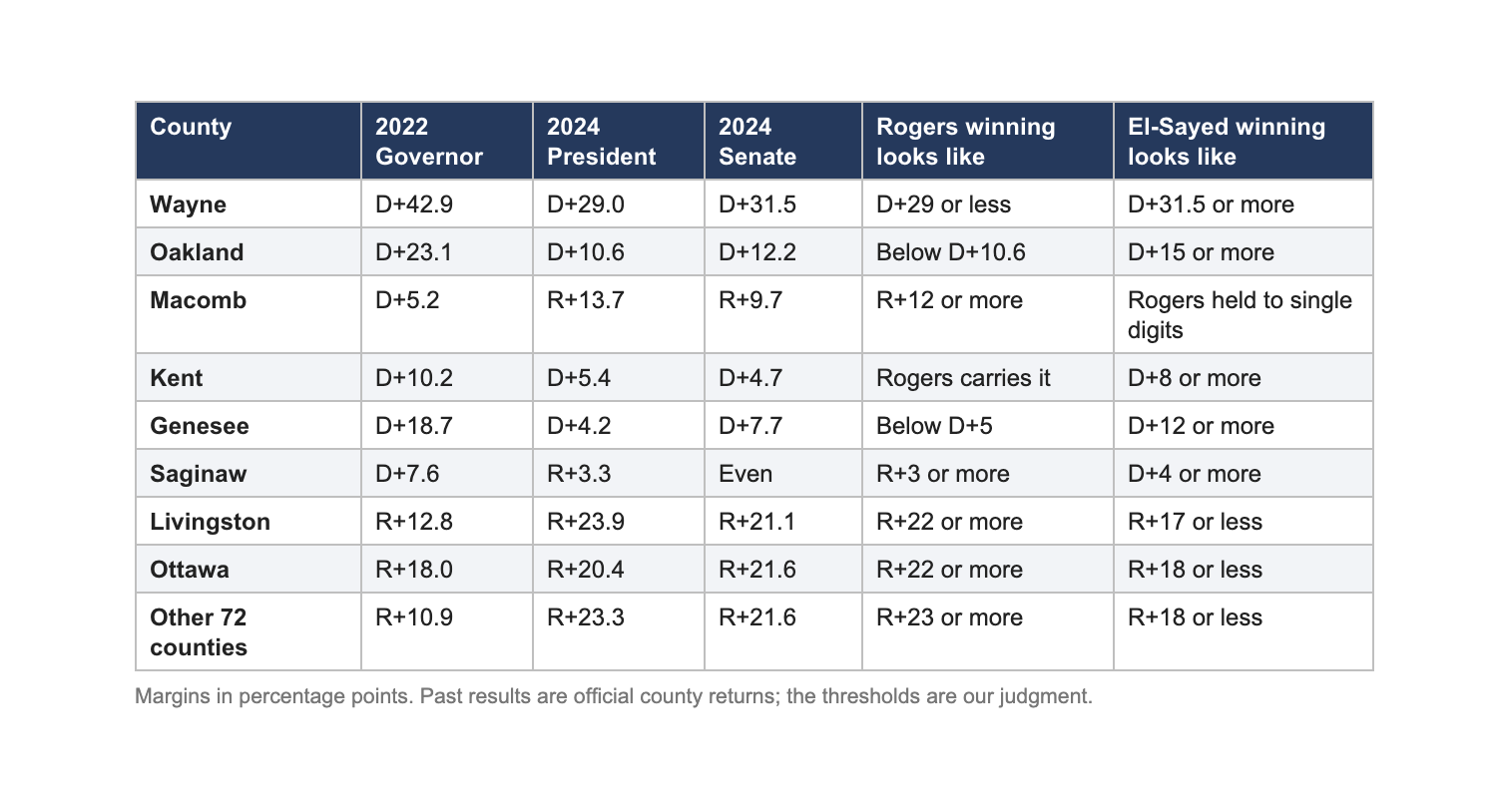
The Stevens test is in Oakland County. Stevens represents an Oakland district. Compare El-Sayed’s margin there with Jocelyn Benson’s. A modest gap is ordinary ticket splitting; a wide one means her voters followed her. Slotkin won Oakland by 12 points, and El-Sayed falling below Harris’s 10.6 would give Rogers a real opening.
Macomb is the biggest lever. Matching Trump’s 14-point margin there would by itself erase Rogers’s 2024 deficit. Rogers by 12 or more is a strong Republican night; single digits forces him to find votes elsewhere.
Wayne tests the early vote. A margin above Slotkin’s 31.5 points means the turnout surge is real. Below Harris’s 29, it was early voting, not new voting.
The 72 smaller counties set the margin. Rogers won them by 21.6 points. Above 23, Election Day is breaking his way. Near 18, the kind of rural shift Virginia saw in 2025, El-Sayed can win comfortably.
The Benson-El-Sayed gap is the statewide Stevens test. Polls have had Benson running about 6 points ahead of El-Sayed, a gap built largely from voters who back Benson for governor and Rogers for the Senate. If the gap holds near that level, Stevens moved few votes. If it opens to 10 points or more, crossover voting is real and the Senate race will be far closer than the governor’s race.
Dearborn shows whether 2024 was a one-time break. In 2024, a swing of roughly 15,000 votes away from Democrats in Dearborn alone made up close to 20% of Trump’s statewide margin. If Dearborn returns to its usual Democratic margins, Wayne will likely clear Slotkin’s 31.5 points. If it stays near its 2024 result, El-Sayed has to make up that ground in the suburbs.
The college counties measure the youth vote. The final Detroit News poll found El-Sayed leading voters ages 18 to 29 by 56 points, after Slotkin and Rogers split that group almost evenly in 2024. Washtenaw and Ingham have already cast about 57% of their 2022 vote. A Washtenaw margin above Slotkin’s 43.8 points would show that lead turning into actual votes.
Saginaw is the bellwether. It has voted for the statewide winner in the 2018 and 2022 governor’s races and the 2024 presidential race, and it split dead even in the 2024 Senate race. Whoever carries Saginaw has very likely carried Michigan.
Don’t read the first returns as a trend. Many clerks tabulate absentee ballots first, so early results lean Democratic, while Election Day ballots, counted later, lean Republican. Because the order differs by county, compare a county with the table only once most of its vote is reported.
Know what too close to call means. Under Michigan’s updated recount law, a statewide race decided by 0.1% of votes cast or less, roughly 4,500 votes at midterm turnout, triggers an automatic recount. Rogers lost by 19,006 votes in 2024. A race inside that range would not have a final answer Tuesday night.
Sunday’s endorsement dominated the final weekend, but the ballots tell a steadier story. More than 2.3 million Michiganders had already voted, the county mix barely moved, and the race still turns on the same places it did in 2024. By Wednesday morning, Oakland and Macomb will show whether the weekend’s biggest headline was noise or the story of the election.