
The Headline That Took Me Back to 2015
by Allie Walker
“Blue Cross touts $147M in savings from the specialty drug equivalent of generics”
That headline stopped me in my tracks last month. Before I tell you why, let me take you back nearly a decade.
In the fall of 2015, I walked into Truscott Rossman as a senior account executive with a new title, a new team — and a client with a clear mission:
Make biosimilar medications available to Michigan patients.
At the time, I had a lot to learn about both Michigan politics and biologic drugs.
Here’s the simple explanation: biosimilars are the equivalent of “generic” versions of biologic medications. Unlike traditional drugs that are chemically synthesized, biologics are made from living organisms — microorganisms, plant cells, or animal cells. They’re complex, highly targeted therapies used to treat cancer, autoimmune diseases, diabetes, and other chronic conditions. Because they are so complex to manufacture, they’re also expensive.
Biosimilars offer a lower-cost alternative that is clinically equivalent in safety and effectiveness to the original biologic product. The FDA defines a biosimilar as a product that is “highly similar to and has no clinically meaningful differences” from an existing FDA-approved biologic. ¹
That sounds straightforward. It wasn’t.
At the time, states across the country were debating how and whether pharmacists could substitute a biosimilar for a prescribed biologic. Concerns about patient safety, notification requirements, and physician authority created real policy tension. What seemed like a small regulatory clarification had major implications for patient access and healthcare costs.
In Michigan, it required legislation.
A Crash Course in Public Affairs
That account threw me headfirst into Michigan public affairs — and into the deep end of my own career.
Over the course of a year, we:
Built a statewide coalition of patient advocates, healthcare providers, and industry partners
Recruited legislative champions
Drafted op-eds and letters of support
Met with lawmakers and staff to answer questions and address concerns
Tracked votes and identified pressure points
Navigated the very human side of policymaking
It was intense. It was strategic. And I loved it.
What struck me most was this: policy isn’t abstract, it’s personal. When you’re talking about access to life-saving medication, you’re talking about families, caregivers, and people managing chronic illness.
We weren’t just advocating for a bill. We were advocating for affordability and access.
After months of work, the legislation passed. We celebrated. The client moved on to the next fight. Lawmakers moved on to the next issue. And at Truscott Rossman, we moved on to the next challenge.
That’s the rhythm of public affairs. You fight hard. You win or lose. Then you pivot.
I filed the experience away as one of those formative early-career chapters.
Then Came the Headline
Fast forward nearly a decade.
The headline I mentioned above caught my attention: biosimilars had saved Michigan patients nearly $150 million in recent years.
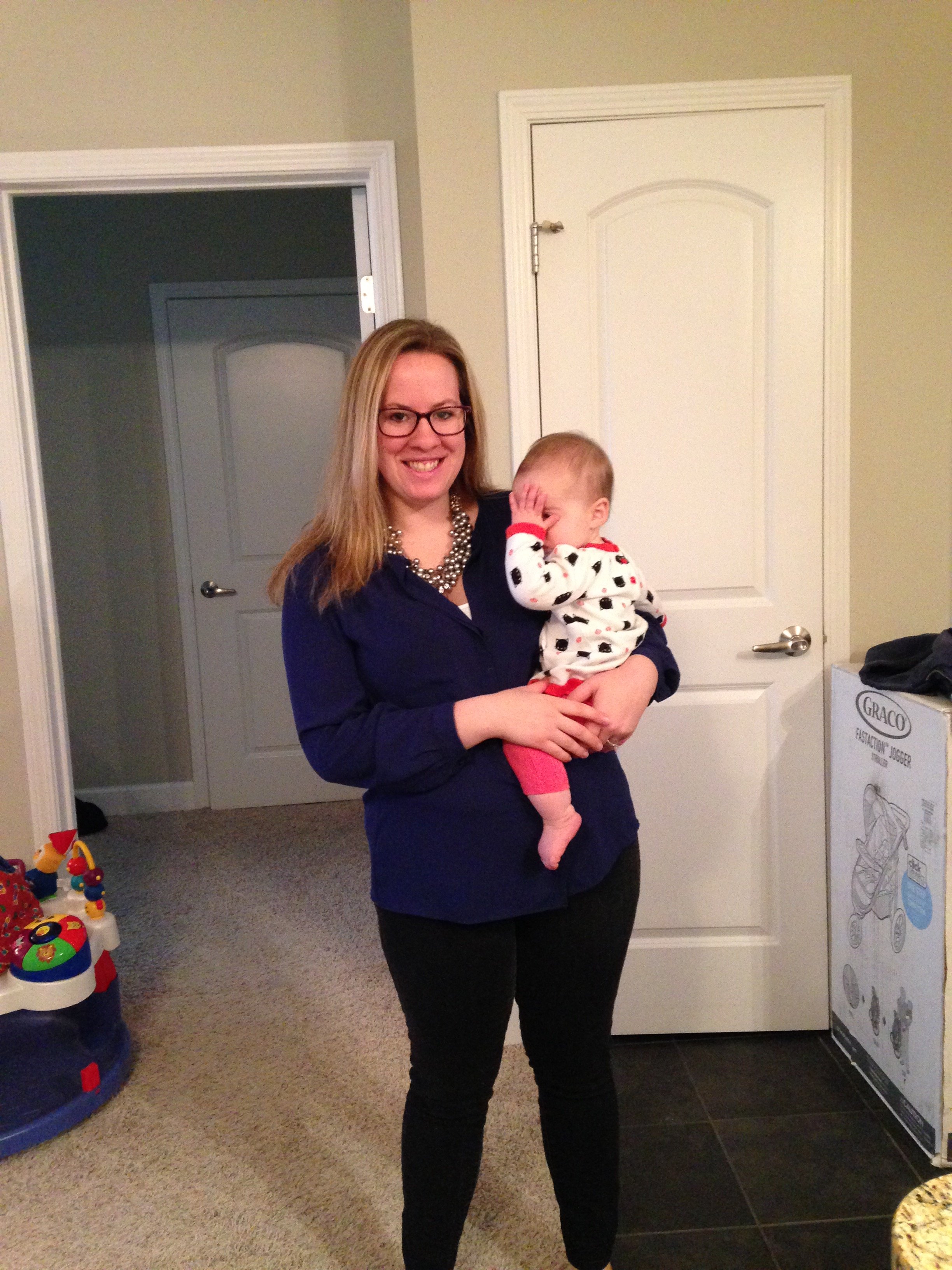
Allie with her daughter, Reiley, in 2015.
That number stopped me.
Nationally, biosimilars have generated more than $36 billion in savings since their introduction, according to IQVIA.² And according to the Association for Accessible Medicines, biosimilars saved U.S. patients and the healthcare system $12.4 billion in 2023 alone. ³
But seeing a Michigan-specific figure — tied to legislation I had worked on — felt different.
Because that’s the thing about public affairs: the real impact rarely shows up in the moment.
The Long Tail of Policy
When you work in public policy, you spend most of your time focused on what’s urgent — today’s vote count, tomorrow’s hearing, next week’s headline.
But legislation doesn’t exist for the news cycle. It exists for the long term.
The work we did in 2015 wasn’t about a press hit or a win in Lansing. It was about creating a framework that would allow patients to access more affordable medication for years — even decades — to come.
And nearly ten years later, the savings are measurable. Families have paid less at the pharmacy counter. Employers have absorbed fewer healthcare costs. The system has functioned more efficiently because of one policy decision.
That’s deeply satisfying.
Why This Matters
One of the privileges of leading a public affairs firm is getting a front-row seat to how ideas become law — and how law becomes impact.
But you don’t always get to see the ending.
So when you do? It’s a reminder of why the work matters.
At Truscott Rossman, we often say that we help clients navigate moments. But what we’re really doing is helping shape outcomes that extend far beyond those moments.
Sometimes it takes ten years — and a surprise headline — to fully appreciate that.
And when it happens, it’s a powerful reminder: public affairs isn’t about noise. It’s about impact.